New Canaan's Notorious Neighbor: James Frey's Fictional Drama Hits Close to Home
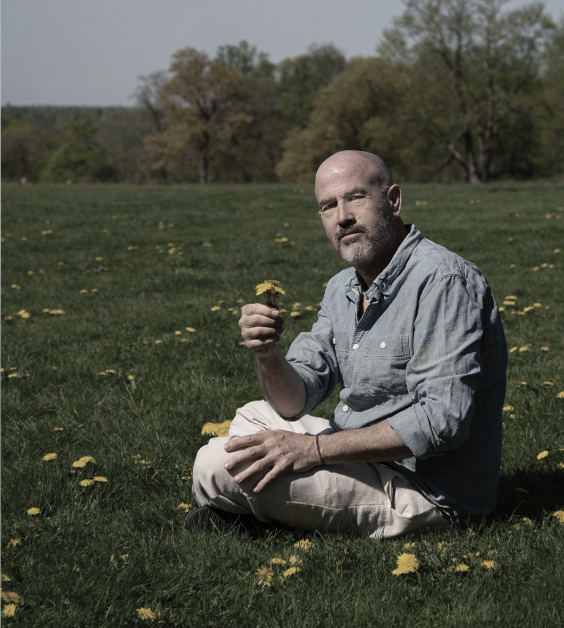
PHOTOGRAPHY BY JANE BEILES
THE APPROACH TO JAMES FREY’S HOUSE FEELS LIKE A DRIVE THROUGH THE PAGES OF HIS LATEST BOOK. The landscape unfolds with rambling farmhouses and faux French chateaus—each boasting a dozen bathrooms and perimeters marked by quaint fieldstone walls that quiet the opulence. It’s particularly picturesque in the bloom of spring, as perfect as New Bethlehem, the fictional town where Frey’s book, Next to Heaven, is set.
It’s no secret that the setting is modeled on New Canaan; the town’s history, outlined in detail by Frey, and its shops, landmarks and parks mirror our own. But are the characters ours, too? That’s the question that left some residents sleepless in their Frette linens as they anticipated the book’s release in June. And now that the juicy novel is out, reading lights are burning bright across the “Next Station to Heaven.”
In his newest release, Frey draws from the salacious novels of Jackie Collins and Danielle Steele—surprising inspirations for an author who says he pursued writing because of men like Henry Miller, Jack Kerouac and Kurt Vonnegut. But Frey is not what one might expect from a man quick to give the world the middle finger.
Frey’s neighborhood is dotted with the occasional modern home, placing us squarely in The Ice Storm country. New Canaan was also the setting for Ang Lee’s 1997 film based on Rick Moody’s eponymous novel about a key party that wreaks havoc on its characters’ lives and community. Next to Heaven features its own spouse-swapping shindig. It’s the kind of thing that can make a small town edgy. Was it based on an actual swingers party? My mission would be to find out.
BEYOND ”THE BIRD”
Frey’s modern home, with its expanse of windows inviting in the surrounding wooded serenity, has been compared to Cameron Frye’s house in Ferris Bueller’s Day Off. On Frey’s lawn are a modern sculpture by Alma Allen and a Nike of Samothrace, goddess of victory. He appreciates art and he appreciates women—in a deeper way than the men at his fictional swingers party do.
Frey has many female friends, including Sarah Hoover, whom he met when she worked at the Gagosian Gallery in New York. She recently wrote a book, Motherload, which lays bare the underbelly of pregnancy and new motherhood. There are plenty of references to “pussies,” but not about getting some, more about stuff that can happen down there that no man wants to hear about. Yet James read the book with relish and moderated Hoover’s book talk at Darien’s Barrett Books in April with sensitivity and an appreciation for both his rookie memoirist friend’s writing and the ordeal she went through with postpartum depression.
Given that empathy, you might assume Frey grew up with sisters. Actually, no girls have graced the family in generations. He has a brother and 12 cousins, all boys. Perhaps because of that, his female friends are ballsy. When he poses for a photo at the talk, his middle finger goes up, and Hoover joins in with gusto. The bird is, after all, Frey’s signature move.
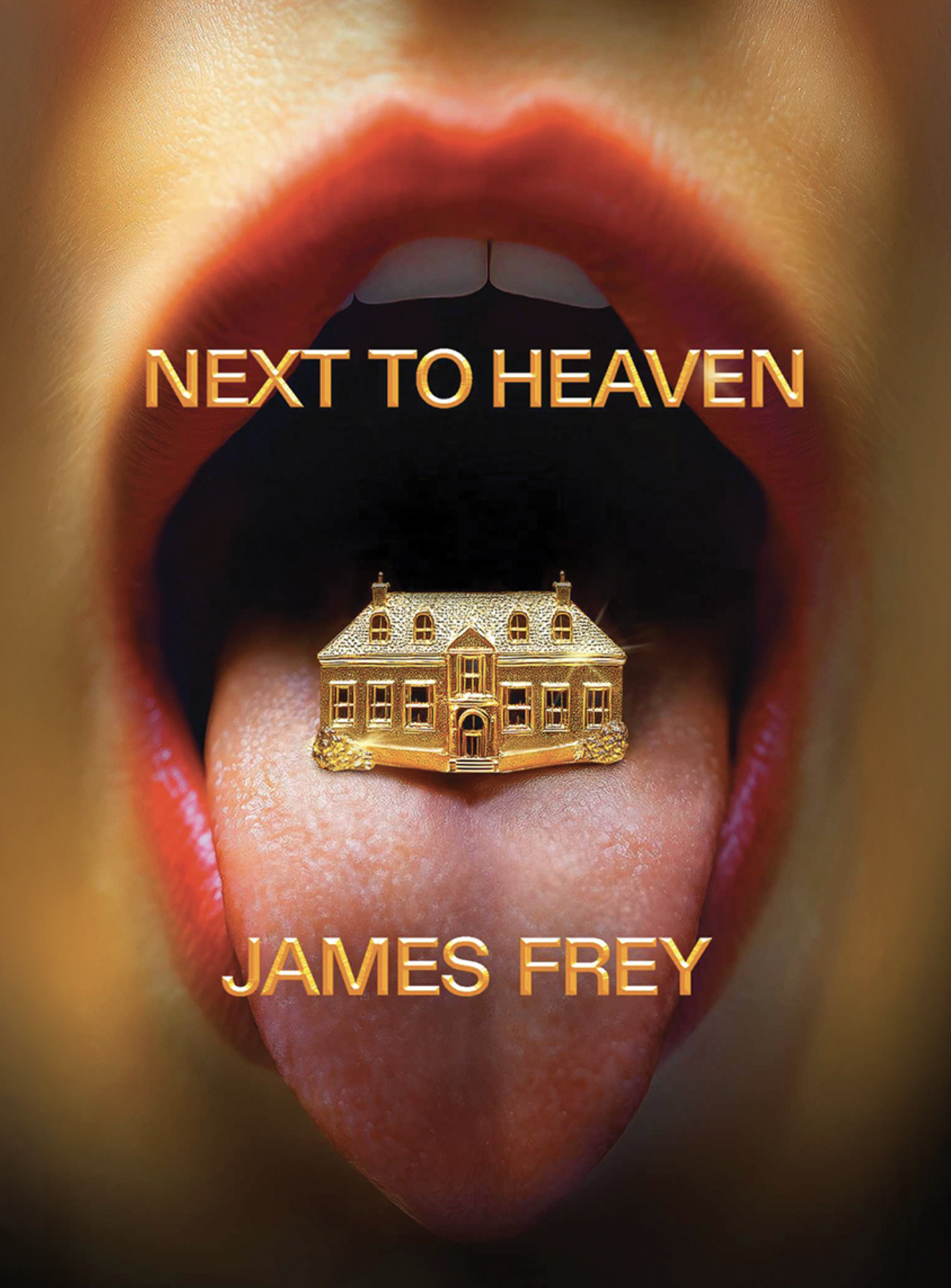
Next to Heaven is poised to be a hit, delivering “rich people behaving badly” drama, similar to White Lotus and The Perfect Couple.
BREAKING THE MOLD
For our interview, Frey is dressed down: paint-splotched khakis, a white tee over a white thermal, black work socks. He seats me in a whirly chair that looks like a spinning seat in a playground. Next to us are shelves of books—nearly all autographed copies. “This bookshelf is organized by influence,” Frey explains, gesturing. “Here are the first copies and manuscripts of all the books I’ve written.” He has penned 20, including multiple global bestsellers, selling 30 million copies worldwide.
The next shelf is devoted to Henry Miller. “I still remember when I read Tropic of Cancer; I couldn’t believe it existed,” says Frey, who was studying film at Denison in Ohio at the time. “A big part of my childhood was reading books. But I had never really believed until I read Henry Miller that I could be a writer. Until then, writers were always these sort of magical people with fancy educations and degrees or crazy backgrounds, crazy stories.” Frey, it turns out, would certainly compile his share of the latter.
Now Frey spends most of his time in his living room. “I live a really quiet, solitary life,” he says. “This is a pretty typical day for me: in this chair, in this house, on this land—reading, writing, listening to music by myself.” He is cross-legged. Tunes from his childhood in the 1970s play. (He was born in ’69.)
This quiet existence, however, belies a past rooted in youthful daring. “A day after I finished Denison, I moved to Paris,” Frey recounts. “I didn’t know anybody, I didn’t have any money, I didn’t have a job. I just went and figured I’d figure it out, same as Henry Miller did.” Miller’s raw, unvarnished prose deeply impacted Frey. “He inspired me to become a writer because he was just a shit talker. The book read like a dude talking shit,” he says. “It was just about life. It was about, you know, going for a walk, reading a book, looking at a painting, meeting a girl, having a drink, fucking. Just simple adventures of a man, of a human. And I believed I could do that.”
Frey spent his twenties developing a “hyper-specific way of writing.” His idiosyncrasies included no paragraph indents, no quotation marks and sentences that could compete in a run-on race with Saul Bellow’s—all indicative of a general disregard for conventional rules. “I think of what I do much more in a way that a painter does,” he explains. Frey generally doesn’t outline or edit. “All of my books are first drafts,” he says. He doesn’t read them either: “That way I remember the process of writing them the best. It’s what matters most to me: that feeling of absolute total focus, of absolute intellectual and emotional focus, and the appearance of the words is always just like kind of a weird joy, seeing pages show up.”
At age 30, Frey wrote his first book, A Million Little Pieces. His bird-flipping habit may have originated in its aftermath. The book was initially marketed as a memoir and even selected by Oprah for her book club, only later to be found to contain fabrications. The ensuing scandal included a public lambasting by Oprah herself and a refund offer to buyers who felt deceived. Yet Frey gave this advice to a fellow writer who was worried about the critique of his partially autobiographical book: “If a book is cool, and entertaining, and moving, then get your middle finger ready and raise it often.” Even if the path was rocky, Frey achieved his dream of a bestseller. Being named “America’s Most Notorious Author” by Time was a bonus.
AN ALTERNATE REALITY
Next to Heaven portrays a world entirely different from A Million Little Pieces. While Million depicts the white-hot pain of a broke rehab patient enduring ordeals like having a cheek sutured and root canals drilled without pain medication, Next to Heaven reveals the gray pain of upper-class malaise, but in the can’t-look-away technicolor of shows like White Lotus and The Perfect Couple, complete with a murder mystery. In Million, the tears of a vulnerable man eventually draw Frey back to rehab from the slippery edge of suicide. It’s as tender as those un-numbed gums.
Next to Heaven is not tender. The book, published by Authors Equity and distributed by Simon & Schuster, is billed as “a satirical thrill ride through the dark heart of privilege.” It’s well-timed to be this summer’s beach read, with a limited-series deal already in the works.
“Somebody asked me to read Hollywood Wives by Jackie Collins to consider adapting it for Hollywood,” says Frey. “I didn’t end up doing that job, but I loved that book. I thought it was so funny and dirty and ridiculous. I started thinking, ‘What would a Jackie Collins’ book look like in today’s world in Connecticut?’ I think we take for granted the extreme bubble we live in, in Fairfield County, and the extreme privilege. I am in no way criticizing those things. I love those things, but it’s not the real world here. And I thought it was just a spectacular setting for a book and one that I hadn’t really ever seen.”
It’s ironic that Frey’s early memoir leaned toward fiction and this novel leans toward reality (at least the reality of a rarified ultra-rich set). Still, he assures that it is fiction. “There’s not a character in the book based on a real person,” Frey states. “There are so many characters around; you can take a little from this person, a little from that person and just use your imagination. But calling it New Bethlehem instead of New Canaan gave me freedom to do whatever I wanted. I think it also gives the town a little freedom to not bear the responsibility of what I write. There’s plausible deniability for everybody.”
He continues, “If I write a book that’s published as nonfiction, everybody tears it apart trying to figure out what’s not true. And if I write a book that’s fiction, everybody tears it apart trying to figure out what is true. Either way, it doesn’t matter to me at all. I sit here, I write these books. They’re an expression of my mind and my soul, and that’s it. I hope people love it. I hope people laugh. I hope people pick it up and once they start, they can’t stop.”
Frey admits some plot points may be inspired by real events. He doesn’t say who or what specifically fed his sexy page-turner. I ask if swingers parties are still a thing or a relic of the swinging ’70s. I’m surprised when he claims they are still a thing. “Well, you live in fucking Westport,” Frey responds, not missing a beat.
For those worried about tarnishing the reputation of our little slice of heaven, he says, “It’s a book. It’s a dirty, funny, dark comedy. We’re all gonna be okay.”

PRIVILEGE AND PARENTING
The author has no reason to bash New Canaan. “I came out here in 2013, honestly, to give my kids the kind of childhood I didn’t have, which was in one place within a community. A place where they could grow and thrive and become whoever they wanted to become,” says Frey, who was born in Cleveland and had a peripatetic boyhood. His 20-year-old daughter is at Barnard, and he has a 17-year-old son and 15-year-old daughter at New Canaan High School. He and their mother are divorced. They lost a newborn to spinal muscular atrophy, he told me, at the book event where Hoover laid bare her postpartum distress. Parenting pain is something he understands.
Despite the fictional portrayal in his new novel, Frey genuinely cherishes his adopted home. “I’m sure people are going to read the book and think I don’t like it here. But it’s the opposite. I love New Canaan,” says Frey, who enjoys daily walks in town and plays hockey—two pastimes that seep into the book. “I love Fairfield County. I think, as much as it is this bubble, it’s this beautiful bubble. It has been a magnificent place to raise kids. It’s safe. It’s got elite education. It’s got great sports programs. I love that it’s cool to be a successful kid here. So the cool kids aren’t the troublemakers or the drug dealers. The cool kids are the kids who get good grades and are good athletes and go to good colleges and are good people. As a parent, I can express those messages, but to have them constantly reinforced by the community and the culture of the community—it has been a joy to live here.”
He acknowledges the inherent pressures: the pressure to be successful, the pressure on kids and the pressure on women especially, “to be thin and beautiful and wear the right clothes and say the right thing and eat at the right restaurants with the right people.” While these pressures exist everywhere, Frey believes they are amplified here: “The competitiveness both creates this place and also sometimes hurts it. The focus on money can be destructive. I think money is a drug—the most powerful, addictive, destructive drug in the world.” To counterbalance this environment, he sends his kids to his parents in Wisconsin for a week every summer. “It’s good for them. It’s not all rich people,” he says.
THE UNCONVENTIONAL MENTOR
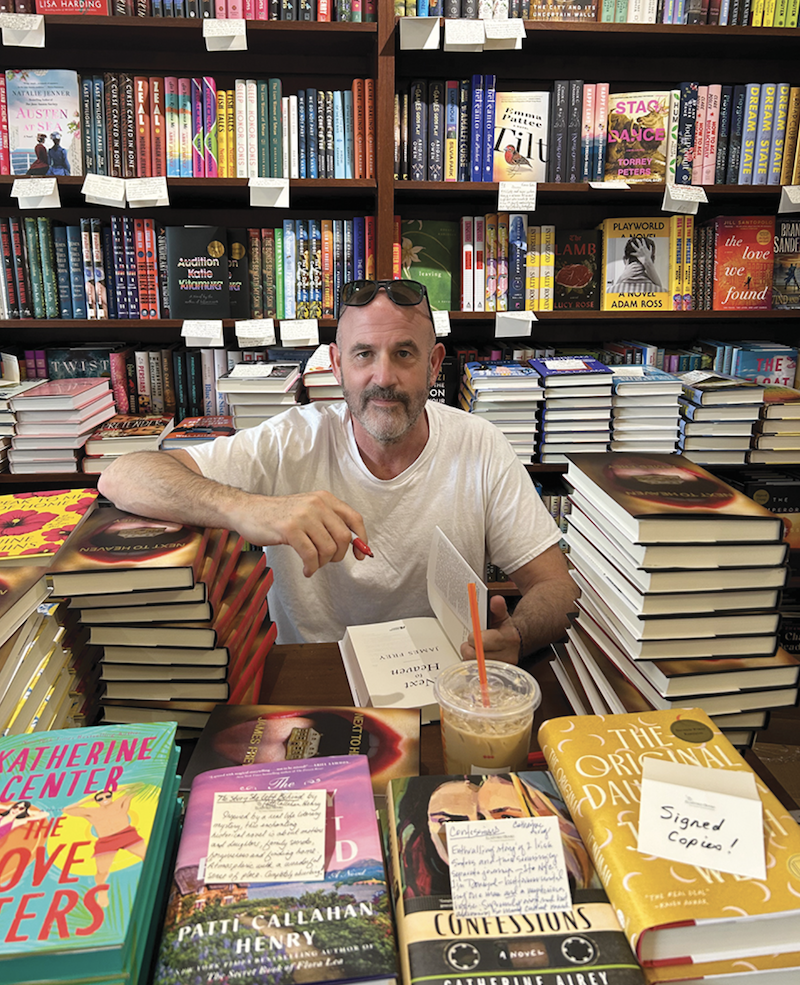
Beyond schools, sports and affluence, another positive of our community bubble is the culture of giving back—and Frey is no exception. He mentors people discreetly, not for credit, but because people helped him. Bret Easton Ellis and Pat Conroy were the first to read A Million Little Pieces. “They were both really kind and generous and cool,” Frey recalls. “So with young writers, or any writer, there are probably three or four people I help at any given time—I’m just like, listen, man, people take care of me, so, yeah, I’m down to do it with you.” He especially appreciates a group of Gen Z writers in New York at Dream Baby Press who reached out to him. “It was extremely gratifying,” he says. “They said, ‘We know the Millennials hate you, but you’re our fucking hero.’” Frey also helps because he hopes “the world of literature, especially boundary-pushing literature, especially controversial troublemaking literature, continues to exist.”
Sarah Hoover says, “As a fellow writer, James is insanely generous and helpful and encouraging. He’s also the kind of solid and supportive friend you feel lucky to have in your orbit. I tell him all the time he’s a mensch. He’s always been that way. He treated me the same when I was an assistant as he does now that I’m a grown up, with my own name on my own book.” She adds, “He loves the phone. He’s one of my favorite people to girl talk with!”
What’s next? Frey just wrote a movie about Charles Bukowski, and he enjoyed writing Next to Heaven so much that he has four more murder mysteries planned, set in the wealthiest parts of the country: Tribeca, East Hampton, Bel Air and Hillsborough, California. Frey says, “The wealth generated over the past decade in the United States—the last time something like it happened was the Gilded Age. Art and literature and television and films are generally reflective of the society that makes them. It’s something that’s in the air: wealth, privilege, how extreme those things have become in our society—for good and for bad.”
Next to Heaven hit newsstands on June 17. It is available at Elm Street Books, Barrett Books and other retailers.